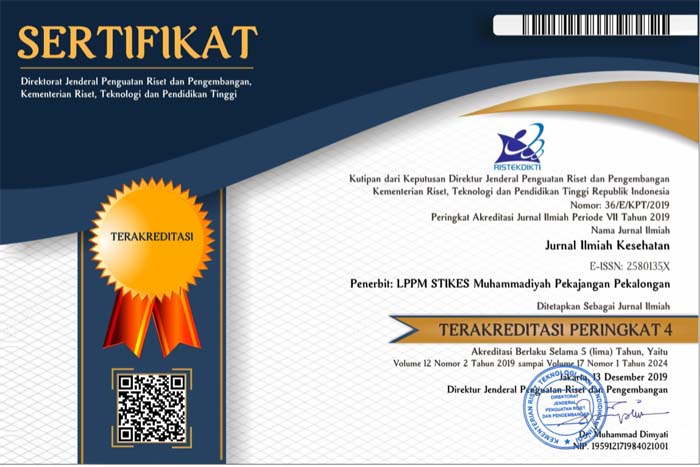
Author information pack
Etika Publikasi
PUBLICATION ETHICS
General Statement
Jurnal Ilmiah Kesehatan is a peer-reviewed, open-access scientific journal published by LPPM Universitas Muhammadiyah Pekajangan Pekalongan. The journal is committed to maintaining the highest standards of publication ethics, research integrity, transparency, accountability, and professional conduct throughout the publication process.
Jurnal Ilmiah Kesehatan publishes original scientific articles covering nursing, midwifery, pharmacy, medicine, public health, and physiotherapy. This publication ethics policy applies to all parties involved in scholarly publishing, including authors, reviewers, editors, editorial board members, and the publisher.
The journal adopts the principles of the Committee on Publication Ethics (COPE) Core Practices and supports the implementation of applicable Indonesian regulations, including the Regulation of the Minister of Education, Culture, Research, and Technology of the Republic of Indonesia Number 39 of 2021 concerning Academic Integrity in Producing Scholarly Works.
Academic Integrity Principles
Jurnal Ilmiah Kesehatan promotes academic integrity as the foundation of responsible scientific communication. All participants in the publication process are expected to uphold the following fundamental values:
- Honesty
- Trust
- Fairness
- Respect
- Responsibility
- Courage
These principles guide ethical decision-making, support research integrity, and promote a responsible academic culture in the health sciences.
Research Integrity and Publication Misconduct
Jurnal Ilmiah Kesehatan is committed to safeguarding the integrity and reliability of the scholarly record. Publication misconduct includes, but is not limited to:
- Fabrication of research data or information.
- Falsification or inappropriate manipulation of research data, methods, images, or findings.
- Plagiarism and inappropriate self-plagiarism.
- Gift, honorary, ghost, or purchased authorship.
- Undisclosed conflicts of interest.
- Multiple, redundant, or simultaneous submissions.
- Misrepresentation of research procedures, ethical approvals, informed consent, or research findings.
- Citation manipulation, coercive citation, and peer-review manipulation.
- Breaches of confidentiality or inappropriate disclosure of research participants' personal and health information.
- Failure to comply with applicable research ethics requirements.
Suspected cases of misconduct will be investigated fairly, confidentially, and objectively. The journal may request clarification or supporting documents from authors, reject manuscripts, publish corrections, issue an expression of concern, or retract published articles, depending on the nature and severity of the case. The journal will follow relevant COPE guidance when handling suspected misconduct.
Complaints and Appeals
Jurnal Ilmiah Kesehatan provides a mechanism for handling complaints and appeals concerning editorial decisions, peer-review processes, publication delays, alleged conflicts of interest, publication misconduct, citation manipulation, and the conduct of editors or reviewers.
Complaints and appeals must be supported by relevant information and will be evaluated fairly, transparently, and confidentially. Authors may appeal editorial decisions by providing a clear scientific justification. Complaints will be handled by an appropriate editor or an independent party when necessary to avoid conflicts of interest.
Ethical Oversight
Authors are responsible for ensuring that their research complies with applicable ethical, legal, and professional standards in the health sciences. Depending on the study design and applicable regulations, authors must provide evidence of:
- Ethical approval: Research involving human participants, patients, identifiable personal data, biological samples, or animals must obtain approval from an appropriate research ethics committee when required.
- Informed consent: Authors must ensure that informed consent has been obtained from participants or their legally authorized representatives when applicable.
- Protection of vulnerable populations: Research involving pregnant women, newborns, children, patients, and other potentially vulnerable groups must include appropriate ethical safeguards.
- Confidentiality and privacy: Identifiable information, medical records, photographs, and other sensitive data must be protected. Authors must obtain appropriate permission for the publication of identifiable information.
- Clinical and health research requirements: Authors must comply with relevant clinical research standards, professional codes, and applicable national regulations. Clinical trial registration must be provided when required by applicable standards or journal policy.
- Animal research: Studies involving animals must comply with applicable animal welfare regulations and ethical review requirements.
- Use of copyrighted materials: Permission must be obtained for the use of copyrighted instruments, images, questionnaires, datasets, and other third-party materials when required.
Authors must accurately report ethical approval details, including the name of the approving committee, approval number, and approval date when applicable. The journal reserves the right to request supporting documentation during editorial evaluation.
Data Availability and Reproducibility
Authors are encouraged to retain research data, analytical procedures, study instruments, and other supporting materials necessary to verify the findings reported in their manuscripts.
The journal may request access to relevant underlying data during editorial evaluation. Authors should ensure that research data are stored securely and made available when appropriate, subject to ethical approval, informed consent, privacy protection, confidentiality, intellectual property rights, and other applicable restrictions.
For clinical, nursing, midwifery, pharmacy, medical, public health, and physiotherapy research, patient-identifiable information and confidential health records must not be disclosed without an appropriate legal and ethical basis. Where data cannot be shared, authors should explain the applicable restrictions in their manuscript.
Authorship and Contributorship
Authorship must reflect substantial intellectual contributions to the research and manuscript. Authors are expected to:
- Make substantial contributions to the conception or design of the study, data collection, analysis, interpretation, or other essential aspects of the research.
- Participate in drafting the manuscript or critically revising it for important intellectual content.
- Approve the final version of the manuscript before submission or publication.
- Accept accountability for their contributions and cooperate in addressing questions concerning the accuracy or integrity of the work.
Individuals who do not meet the criteria for authorship should be acknowledged appropriately, with their permission where necessary.
Gift authorship, honorary authorship, ghost authorship, and purchased authorship are considered unethical. Changes in authorship after submission must be justified to the editor and approved by all affected authors.
Conflicts of Interest and Funding Transparency
Policy Statement
Jurnal Ilmiah Kesehatan is committed to ensuring that editorial decisions, peer review, and publication are conducted fairly, objectively, and transparently. All authors, editors, editorial board members, and peer reviewers must disclose any actual, potential, or perceived conflicts of interest that could influence, or reasonably appear to influence, their judgment, conduct, or interpretation of research.
A conflict of interest does not automatically mean that research or a manuscript is inappropriate. However, failure to disclose a relevant conflict may undermine the transparency and credibility of the publication process.
Types of Conflicts of Interest
Conflicts of interest may be financial or non-financial and include, but are not limited to:
- Financial interests: research grants, honoraria, consultancy fees, employment, paid expert testimony, stock ownership, patents, royalties, or other financial relationships with organizations relevant to the manuscript.
- Personal relationships: family relationships, close personal relationships, personal disputes, or other circumstances that may affect impartial judgment.
- Professional or academic relationships: recent collaboration, supervisory relationships, competition, or other professional connections with authors or organizations involved in the work.
- Institutional interests: affiliations or responsibilities that could benefit or disadvantage an institution, department, organization, or employer.
- Intellectual or ideological interests: strong academic, theoretical, or public positions that could reasonably be perceived to affect an impartial assessment.
- Funding-related interests: financial or other support from an organization that may benefit from the study's findings or publication.
Responsibilities of Authors
Authors must disclose all relevant conflicts of interest when submitting a manuscript. The disclosure should identify the nature of the relationship and explain any relevant role in the research or publication process. Authors must also disclose all sources of financial support and describe the role of each funder, where applicable, in the study design, data collection, analysis, interpretation, manuscript preparation, and decision to submit or publish the manuscript.
If no competing interests exist, authors should include the following statement in the manuscript:
“The authors declare no competing interests.”
If funding was received, authors should provide the name of the funding organization and any grant or award number, if applicable. If the funder had no role in the research or publication process, this should be stated where relevant. All listed authors are responsible for ensuring that disclosures are complete and accurate.
Responsibilities of Editors and Editorial Board Members
Editors and editorial board members must disclose any actual or potential conflicts of interest related to a submitted manuscript, its authors, or the institutions and organizations involved. An editor who has a conflict must not make the editorial decision or otherwise participate in handling the manuscript. The manuscript should be reassigned to an independent editor.
Editorial decisions must not be influenced by personal, financial, institutional, professional, or commercial interests. Editors must maintain confidentiality and protect the independence and fairness of the editorial process.
Responsibilities of Peer Reviewers
Peer reviewers must disclose any actual or potential conflict of interest before accepting or continuing a review assignment. Reviewers should decline the assignment if a conflict could compromise, or reasonably be perceived to compromise, their impartiality. Examples include close personal relationships, recent collaboration, supervisory relationships, direct competition, or financial or institutional interests involving the authors or the research.
Reviewers must not use unpublished information obtained through peer review for personal, professional, or financial advantage. If a relevant conflict becomes apparent during the review, the reviewer must inform the editor promptly.
Editorial Assessment and Management
The journal may request additional information or clarification when a disclosure is incomplete or when a potential conflict is identified. Depending on the circumstances, the journal may assign an independent editor or reviewer, require a disclosure statement, publish relevant disclosures with the article, or take other appropriate measures to protect the integrity of the editorial process.
If a conflict of interest is discovered after publication and was not adequately disclosed, the journal will assess the matter fairly and transparently. Depending on the seriousness and effect on the published record, the journal may publish a correction, issue an expression of concern, or take other appropriate action in accordance with its publication ethics policies and relevant COPE guidance.
Disclosure in Published Articles
Relevant conflict-of-interest and funding statements will be included in the published article. Where applicable, statements should distinguish between the absence of competing interests and the absence of external funding. Authors must not use a “no competing interests” statement to imply that no funding was received if funding was in fact provided.
Jurnal Ilmiah Kesehatan expects all parties to disclose relevant interests honestly and promptly. Disclosure supports transparency and enables editors, reviewers, and readers to assess the context in which the research was conducted and reported.
Citation Integrity
Jurnal Ilmiah Kesehatan expects all references and citations to be relevant, accurate, verifiable, and academically justified. Citations should appropriately acknowledge previous research and support the scientific arguments presented in the manuscript.
The journal does not tolerate excessive self-citation, coercive citation, citation stacking, citation cartels, or other practices intended to manipulate citation metrics. Authors, reviewers, and editors must not request irrelevant citations for personal, institutional, or journal-related advantage.
Responsibilities of the Publisher
LPPM Universitas Muhammadiyah Pekajangan Pekalongan, as the publisher of Jurnal Ilmiah Kesehatan, is committed to supporting ethical scholarly publishing and protecting editorial independence.
The publisher ensures that advertising, reprints, sponsorship, or other commercial activities do not influence editorial decisions. The publisher also supports editors in addressing publication ethics concerns and communicating with other journals, publishers, institutions, or relevant authorities when necessary.
Responsibilities of Editors
Editors are responsible for maintaining the quality, integrity, fairness, and transparency of the editorial process. Editors shall:
- Make editorial decisions based on the scientific quality, originality, relevance, methodological rigor, ethical compliance, and contribution of manuscripts to the journal's scope.
- Ensure that manuscripts undergo an appropriate peer-review process and that editorial decisions are supported by relevant reviewer assessments and independent editorial judgment.
- Process manuscripts fairly and in a timely manner, without discrimination based on race, gender, sexual orientation, religious belief, ethnic origin, nationality, institutional affiliation, or political philosophy.
- Assess whether manuscripts fall within the journal's scope, covering nursing, midwifery, pharmacy, medicine, public health, and physiotherapy.
- Ensure that submitted manuscripts undergo appropriate plagiarism or similarity screening.
- Maintain the confidentiality of submitted manuscripts and disclose information only to authorized individuals involved in the editorial process.
- Manage conflicts of interest and assign manuscripts to independent editors or reviewers when necessary.
- Encourage authors to improve their manuscripts through constructive, scientifically justified feedback.
- Take appropriate action when ethical concerns or suspected misconduct arise before or after publication.
- Protect the integrity of the published scholarly record through corrections, expressions of concern, and retractions when warranted.
Editors shall not:
- Discriminate against authors based on personal characteristics or institutional affiliation.
- Use unpublished information for personal research or professional advantage without appropriate permission.
- Allow personal, institutional, financial, or commercial interests to influence editorial decisions.
- Override ethical requirements or ignore credible allegations of research misconduct.
Responsibilities of Authors
Authors are responsible for the originality, accuracy, validity, and integrity of their work. Authors shall:
- Submit original research, reviews, case reports, and other scholarly contributions that fall within the journal's scope and accepted article categories.
- Present research methods, data, analyses, and findings accurately and honestly.
- Follow the journal's author guidelines, manuscript template, and submission requirements.
- Ensure that the manuscript has not been published previously and is not under consideration by another journal at the same time.
- Obtain appropriate ethical approval, informed consent, and permissions when required.
- Protect the privacy and confidentiality of research participants, particularly patients and vulnerable populations.
- Properly acknowledge all sources and cite relevant literature.
- Disclose funding sources, competing interests, and the use of AI-assisted technologies in accordance with journal policy.
- Cooperate with reviewers and editors by responding to comments and submitting revisions within the specified timeframe.
- Notify the editor promptly if significant errors are discovered after submission or publication.
- Inform the editor in writing if they wish to withdraw a manuscript before the publication process is complete.
Authors shall not fabricate or falsify data, plagiarize, manipulate citations, misrepresent ethical approval, conceal conflicts of interest, or engage in inappropriate authorship practices.
Responsibilities of Reviewers
Reviewers contribute to the quality, credibility, and scientific rigor of articles published in Jurnal Ilmiah Kesehatan. Reviewers shall:
- Accept review assignments only when the manuscript falls within their expertise and they can complete the review within the agreed timeframe.
- Evaluate manuscripts objectively, critically, and constructively.
- Provide clear recommendations supported by scientific reasoning, methodological assessment, and relevant references when appropriate.
- Assess the originality, validity, relevance, ethical compliance, and contribution of the research to the health sciences.
- Maintain the confidentiality of manuscripts and all information obtained during peer review.
- Inform the editor of suspected plagiarism, data fabrication, ethical concerns, or other potential misconduct.
- Disclose any actual or potential conflicts of interest before accepting or continuing a review assignment.
Reviewers shall not use unpublished information for personal advantage, share confidential manuscript content with unauthorized parties, allow personal bias to influence their assessment, or contact authors directly about manuscripts under review without editorial authorization.
Corrections, Retractions, and Post-Publication Discussions
Jurnal Ilmiah Kesehatan recognizes that errors or ethical concerns may emerge after publication. The journal is committed to correcting the scholarly record when necessary.
- Corrections: Published when errors require correction but do not invalidate the overall reliability of the article.
- Expressions of concern: Issued when credible concerns arise and an investigation is ongoing or the available evidence is insufficient for a final decision.
- Retractions: Issued when findings are unreliable because of major errors, fabrication, falsification, plagiarism, serious ethical violations, or other grounds consistent with recognized publication ethics standards.
- Post-publication discussion: The journal may consider scholarly comments, responses, and other substantiated concerns regarding published articles.
All post-publication actions will be handled transparently and in accordance with relevant COPE recommendations. Where appropriate, notices will clearly identify the affected article and explain the reason for the action.
Artificial Intelligence (AI) and AI-Assisted Technologies
The use of generative artificial intelligence and AI-assisted technologies must comply with the journal's publication policies and applicable ethical standards.
Authors remain fully responsible for the accuracy, originality, integrity, and reliability of all submitted content. AI systems cannot be listed as authors because they cannot assume responsibility for scholarly work, approve the final manuscript, or respond to questions concerning its integrity.
Authors must disclose the use of AI-assisted technologies when required by the journal's policy, particularly when such tools contribute to manuscript preparation, data analysis, image generation, or other substantive aspects of the research. The disclosure should identify the tool and describe its purpose and scope of use.
AI tools must not be used to fabricate research data, generate misleading images or results, create false references, manipulate peer review, or compromise the confidentiality of unpublished manuscripts or sensitive research data.
Editors and reviewers must protect manuscript confidentiality and must not upload confidential manuscript content or sensitive research information to AI tools when doing so could breach confidentiality, privacy, or applicable journal policies.
Ethical Commitment
Jurnal Ilmiah Kesehatan is committed to promoting responsible research, ethical clinical and health-related studies, transparent peer review, and trustworthy scientific communication. The journal expects all authors, reviewers, editors, editorial board members, and the publisher to uphold high standards of professional conduct and contribute to the advancement of reliable scientific knowledge in nursing, midwifery, pharmacy, medicine, public health, and physiotherapy.
References
- Committee on Publication Ethics (COPE). Core Practices. Available at: https://publicationethics.org/core-practices
- Committee on Publication Ethics (COPE). Retraction Guidelines. Available at: https://publicationethics.org/retraction-guidelines
- Committee on Publication Ethics (COPE). Ethical Guidelines for Peer Reviewers. Available at: https://publicationethics.org/resources/guidelines/cope-ethical-guidelines-peer-reviewers
- Republic of Indonesia. Regulation of the Minister of Education, Culture, Research, and Technology Number 39 of 2021 concerning Academic Integrity in Producing Scholarly Works.