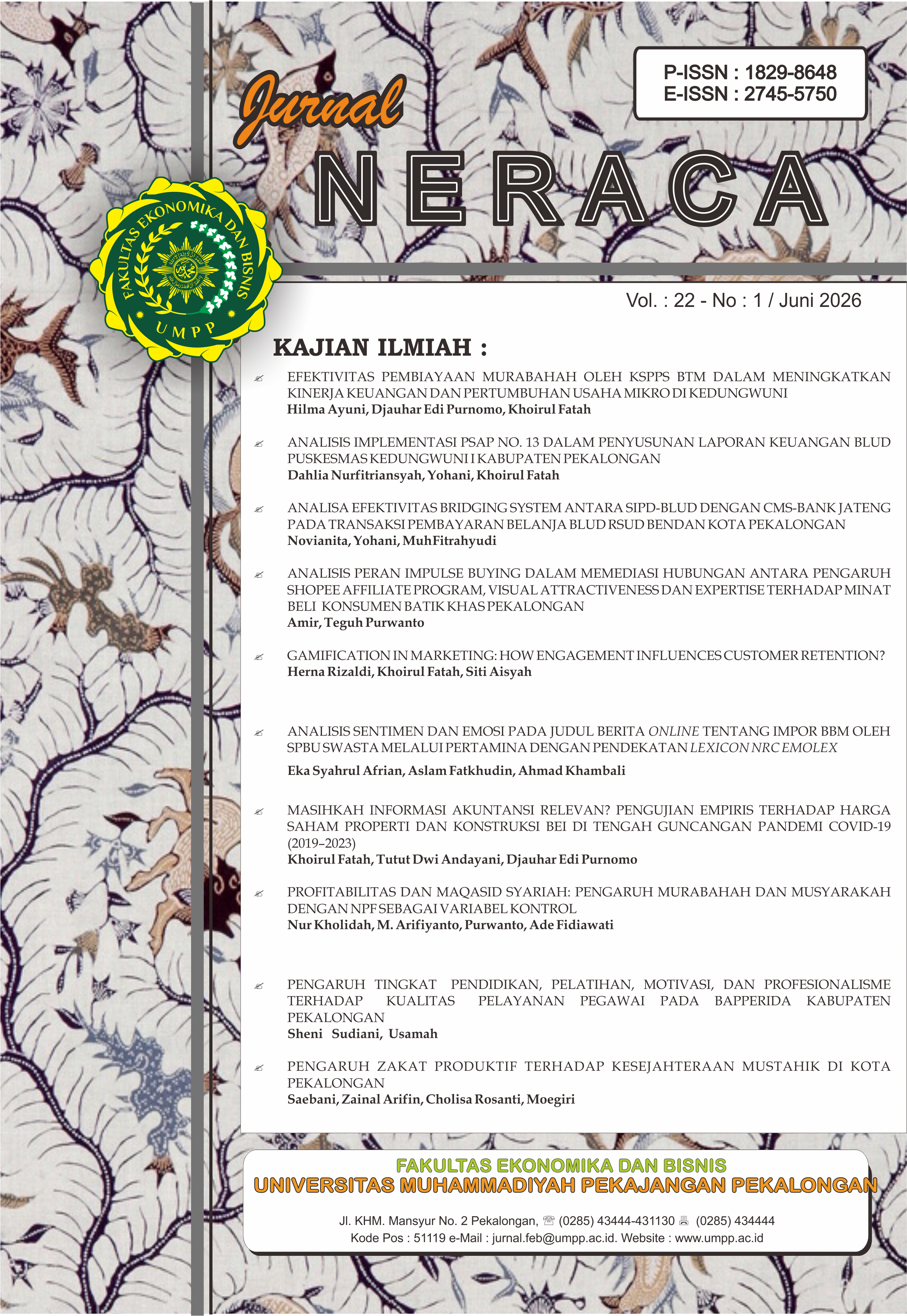
GAMIFICATION IN MARKETING: HOW ENGAGEMENT INFLUENCES CUSTOMER RETENTION?
DOI:
https://doi.org/10.48144/neraca.v22i1.2468Keywords:
Gamification, Customer_retention, E-Commerce, Customer_engagement, mediating roleAbstract
This study aims to analyze the effect of gamification on customer retention and to examine the mediating role of customer engagement among users of the e-commerce platforms Tokopedia, TikTok Shop, and Shopee. The study employs a quantitative approach with a sample of 96 respondents, comprising students, civil servants (ASN), and entrepreneurs located in the regions of Banyumas, Banjarnegara, Purbalingga, and Cilacap. Data collection was conducted using a structured questionnaire, while data analysis employed the Partial Least Squares Structural Equation Modeling (PLS-SEM) method using the SmartPLS software. The results indicate that gamification has a positive and significant effect on customer retention. Additionally, gamification also has a positive and significant effect on customer engagement, while customer engagement was found to have a positive and significant effect on customer retention. The results of the indirect effect test show that customer engagement partially mediates the relationship between gamification and customer retention. These findings suggest that the implementation of gamification elements such as points, rewards, challenges, and interactive missions can increase consumer engagement, which ultimately strengthens customer retention. This study implies that effective gamification strategies can serve as a means for e-commerce platforms to boost user engagement and retain customers over the long term.
REFERENCES
Hamari, J., Koivisto, J., & Sarsa, H. (2014). Does gamification work? – A literature review of empirical studies on gamification. Proceedings of the 47th Hawaii International Conference on System Sciences, 3025–3034
Zichermann, G., & Cunningham, C. (2011). Gamification by design: Implementing game mechanics in web and mobile apps. O'Reilly Media
Huotari, K., & Hamari, J. (2017). A definition for gamification: Anchoring gamification in the service marketing literature. Electronic Markets, 27(1), 21–31.
Brodie, R. J., Hollebeek, L. D., Jurić, B., & Ilić, A. (2011). Customer engagement: Conceptual domain, fundamental propositions, and implications for research. Journal of Service Research, 14(3), 252–271.
Vivek, S. D., Beatty, S. E., & Morgan, R. M. (2012). Customer engagement: Exploring customer relationships beyond purchase. Journal of Marketing Theory and Practice, 20(2), 122–146.
Hollebeek, L. D., Glynn, M. S., & Brodie, R. J. (2014). Consumer brand engagement in social media: Conceptualization, scale development and validation. Journal of Interactive Marketing, 28(2), 149–165.
Werbach, K., & Hunter, D. (2012). For the win: How game thinking can revolutionize your business. Wharton Digital Press.
Blohm, I., & Leimeister, J. M. (2013). Gamification: Design of IT-based enhancing services for motivational support and behavioral change. Business & Information Systems Engineering, 5(4), 275–278.
Reichheld, F. F., & Schefter, P. (2000). E-loyalty: Your secret weapon on the web. Harvard Business Review, 78(4), 105–113.
Gallo, A. (2014). The value of keeping the right customers. Harvard Business Review.
Kim, S., Lee, J., & Suh, E. (2018). Sustaining users’ activity in social media: An empirical examination of social capital, motivation, and ability. International Journal of Information Management, 39, 232–242.
Yee, N. (2017). The gamer’s brain: How neuroscience and UX can impact video game design. Quarto Publishing Group.
Deterding, S., Dixon, D., Khaled, R., & Nacke, L. (2011). From game design elements to gamefulness: Defining "gamification". Proceedings of the 15th International Academic MindTrek Conference: Envisioning Future Media Environments, 9–15.
Hamari, J., Koivisto, J., & Sarsa, H. (2014). Does gamification work? – A literature review of empirical studies on gamification. Proceedings of the 47th Hawaii International Conference on System Sciences (HICSS), 3025-3034.
Werbach, K., & Hunter, D. (2012). For the win: How game thinking can revolutionize your business. Wharton Digital Press.
Blohm, I., & Leimeister, J. M. (2013). Gamification: Design of IT-based enhancing services for motivational support and behavioral change. Business & Information Systems Engineering, 5(4), 275-278.
Nicholson, S. (2015). A recipe for meaningful gamification. In T. Reiners & L. C. Wood (Eds.), Gamification in Education and Business, 1-20. Springer.
Joshi, A., Kale, S., Chandel, S., & Pal, D. K. (2015). Likert scale: Explored and explained. British Journal of Applied Science & Technology, 7(4), 396–403.
Hair, J. F., Risher, J. J., Sarstedt, M., & Ringle, C. M. (2017). When to use and how to report the results of PLS-SEM. European Business Review, 31(1), 2–24.
Henseler, J., Ringle, C. M., & Sinkovics, R. R. (2009). The use of partial least squares path modeling in international marketing. Advances in International Marketing, 20, 277–319.
Chin, W. W. (1998). The partial least squares approach for structural equation modeling. In G. A. Marcoulides (Ed.), Modern Methods for Business Research (pp. 295–336). Lawrence Erlbaum Associates.
Fornell, C., & Larcker, D. F. (1981). Evaluating structural equation models with unobservable variables and measurement error. Journal of Marketing Research, 18(1), 39–50.
Baron, R. M., & Kenny, D. A. (1986). The moderator–mediator variable distinction in social psychological research: Conceptual, strategic, and statistical considerations. Journal of Personality and Social Psychology, 51(6), 1173–1182